
Raksha Bandhan at home: the thali, the timing, and feeding everyone afterwards
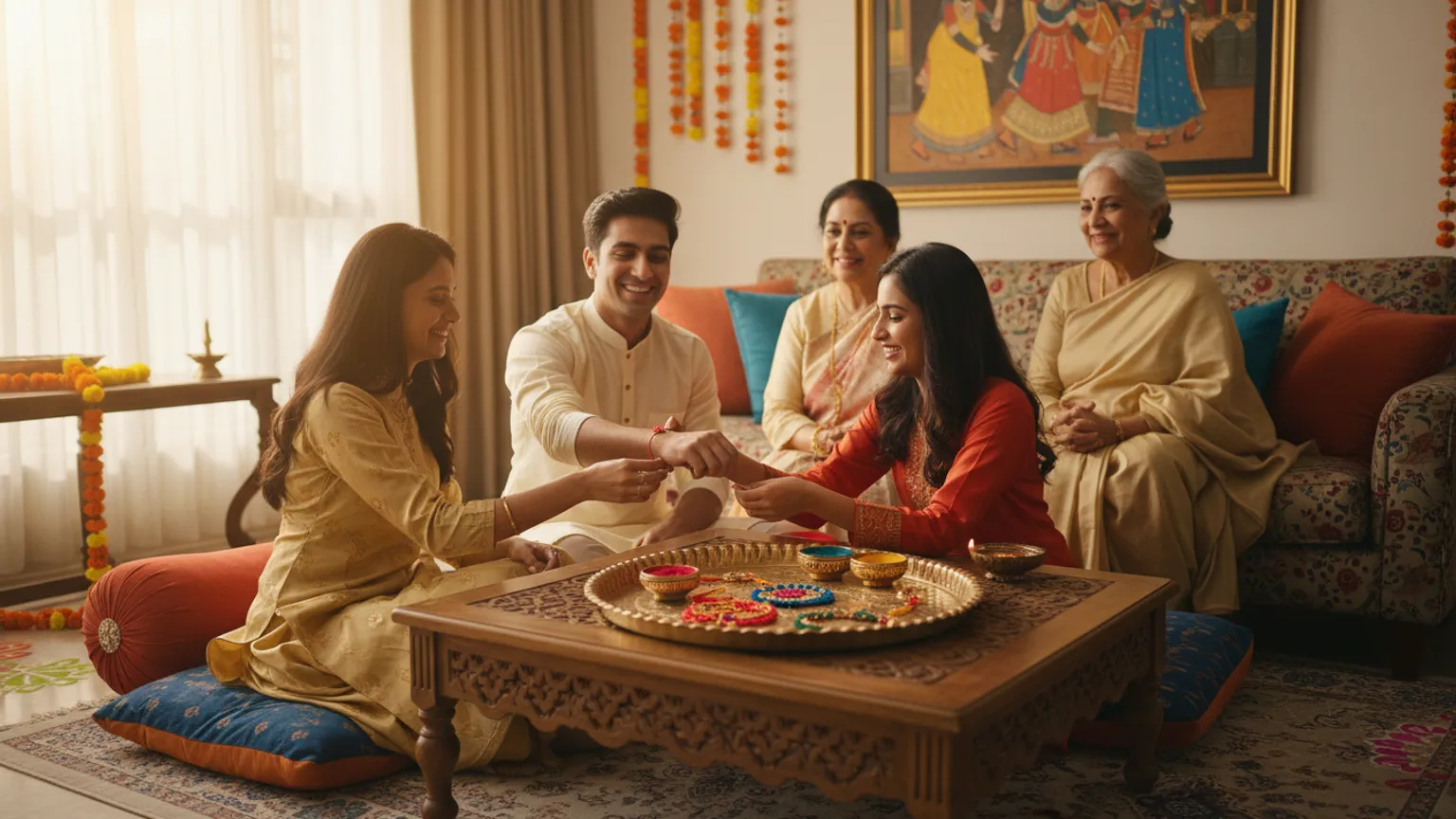
Raksha Bandhan is the only festival in the Indian calendar where the ceremony takes ninety seconds and the logistics take all day. The tying itself is quick. What is not quick is getting four siblings, two sets of cousins, an aunt who is "just coming for ten minutes", and a grandmother who will not eat until everyone has eaten, into the same room at roughly the same hour.
Most Rakhi-day stress is not about the rakhi. It is about a house that fills up in waves, an auspicious window that closes, and a kitchen that has to be ready before you know how many people are actually coming.
This is the host's side of the day.
The first year Rakhi happened at our own place instead of at an elder's, I made the classic mistake: I told everyone "subah aa jao" and left the timing at that. Bhadra that year ran past noon, so my morning became meeting each car at the gate to explain the tying would only be after lunch — while, inside, the mithai box I had left out on the table quietly emptied. By the time the window actually opened I was fishing the ceremony laddoo back off a cousin's plate. None of that was the festival's fault. It was mine, for messaging a feeling instead of a time, and for not keeping one plate of sweets out of everyone's reach.
Bhadra is why your morning is not yours to plan
The single thing that reorganises a Raksha Bandhan schedule is Bhadra. Raksha Bandhan falls on Shravan Purnima, and Purnima frequently begins with a Bhadra period — a stretch traditionally considered inauspicious for tying the rakhi. Many families will not tie during it. So the ceremony gets pushed to whenever Bhadra ends, which some years is mid-morning and other years is well into the afternoon.
Two practical consequences follow, and they catch first-time hosts every single time:
- You cannot promise a time until you have checked the panchang for your city. Bhadra timings shift by location, the same way sunrise does. Check Drik Panchang or your family's usual panchang for your own city — not a national headline, and not last year's timing.
- Whatever that time is, your guests will arrive around it, not at it. People leave home when the muhurat starts, which means they arrive after it starts.
The fix is boring and it works: send the actual window, not the word "morning". A message that says "Bhadra ends around 1:40 pm here, so we'll tie between 2 and 3 — please reach by 1:45" produces a room that is full at 2. A message that says "come in the morning na" produces a room that fills between 9 am and 4 pm, and a kitchen that reheats lunch four times.
If someone is joining by video call from abroad, check their clock before you fix the time rather than after. A brother in New Jersey is nine and a half hours behind Delhi, so a 2 pm tying reaches him at 4:30 am. Often the honest answer is not to force one time on everyone — do that pair's ceremony on a separate call at an hour that suits them, and let the house run on its own schedule.
What actually goes on the thali
The thali is simpler than the internet makes it look. The traditional set is:
| Item | What it is for | Rough quantity for one thali |
|---|---|---|
| Roli or kumkum | The tilak | A small katori, refilled as needed |
| Akshat (unbroken rice) | Pressed onto the tilak | 2–3 tablespoons |
| Diya with ghee | The aarti | 1 diya, plus spare wicks |
| Rakhis | The ceremony | One per brother, plus 2 spare |
| Mithai | Fed immediately after | 1 piece per person, kept separate |
| Water in a small lota | Ritual pouring, hand rinsing | 1 |
Two host-side notes that matter more than the list:
Count thalis by sister, not by family. If three sisters are tying, three sisters each want their own thali — sharing one means two of them stand around waiting while the roli travels. Three modest thalis beat one elaborate one.
Keep the ceremony mithai separate from the serving mithai. The piece fed at the tying should not come out of the box that guests are eating from, because the box empties before the ceremony starts. Set aside one piece per pair, in a separate katori, before anyone arrives.
Unbroken rice means unbroken. Akshat is specifically whole grains — pick out the broken ones the night before. It takes five minutes and it is the sort of detail elders notice.
The quantities nobody tells you
Rakhi is a mithai-heavy, meal-light festival for guests who visit briefly, and a full-lunch festival for the ones who stay. The mistake is planning for one pattern.
Split your headcount into two numbers before you order anything:
- Visitors — the cousin who comes, ties, eats a laddoo and leaves. Plan 2 pieces of mithai per person, because everyone takes one and about half take a second.
- Stayers — siblings, parents, whoever is there for the meal. Plan a full lunch portion each, and add a 15% cushion, because Rakhi lunches always acquire one or two extra people.
For a house expecting, say, 12 visitors and 10 stayers, that is roughly 24 pieces of mithai plus lunch for 12 — not lunch for 22, and not mithai for 10. Getting these two numbers separately is the difference between a comfortable afternoon and a 3 pm run to the sweet shop.
The same split applies to seating. You do not need 22 chairs. You need enough for the stayers to sit down at once, and standing room for the wave.
The part that actually goes wrong
The single most common Rakhi-day failure is not food and not timing. It is not knowing who is coming.
Rakhi sits awkwardly in the invitation world: nobody sends a formal invite to their own siblings, so nothing is ever confirmed. "Aa rahe hain" from a family group can mean four people or nine, and it can quietly mean zero if a child falls ill. The result is that you plan for a number you invented.
The lightest fix is a single message to each household — not to the group — two days ahead, asking one specific question. Sent individually, that gets answered. Sent to a group of eighteen, it does not, for the same reason nobody replies to a group invitation: when you ask everyone, nobody feels responsible.
Copy this, put in your own Bhadra window, and send it one household at a time:
Rakhi Sunday ko ghar pe kar rahe hain. Bhadra yahan [1:40 pm] tak hai, so tying 2–3 ke beech — try to reach by 1:45. Bas do cheezein bata do: kitne log aa rahe ho, aur lunch yahin karoge? Kitchen ko count dena hai. 🙏
If you would rather not chase eleven separate chats, a shared guest list where each household confirms its own count does the same job with less typing — that is the problem Inyeet exists for. But for a gathering of twenty, honestly, eleven individual WhatsApp messages sent on Wednesday evening will do it just as well. Use the tool when the list gets long enough that you have lost track of it, not before.
If you are hosting for the first time
Do these five things and the day mostly runs itself:
- Check your city's Bhadra timing the night before, not on the morning itself.
- Message the window, with a reach-by time, to each household separately.
- Ask two questions in that message: how many, and are you eating.
- Set aside ceremony mithai in a separate katori before anyone arrives.
- Count thalis by sister and keep two spare rakhis on the tray.
The ninety seconds will take care of themselves. It is the eleven hours around them that need a plan.
Rakhi is also the year's quiet start to festival season — Janmashtami follows within a week, and Ganesh Chaturthi within three. If you are the person in your family who ends up hosting all of them, the guest-counting problem is about to repeat itself four more times before Diwali. Worth getting the counting method right now rather than in November.
Related reading
Raksha Bandhan at home: hosting siblings and cousins who all arrive together
When several sibling families land at your door in the same fifteen minutes, Rakhi becomes an arrivals problem. A host's plan for the stagger and the crowd.
Navratri 2026 dates and the nine-day plan for a home host
Navratri 2026 runs 11 to 20 October: the full nine-day tithi calendar, how hosting differs by tradition, and where guest-list pressure actually lands.
Shraddh bhoj: how many to invite and what to serve at the meal
A shraddh bhoj is a measured satvik meal, not a party. How many brahmins and family to invite, the traditional menu, real quantities, and copy-paste messages.