
Vishwakarma Puja at the workshop: feeding the whole team without running short
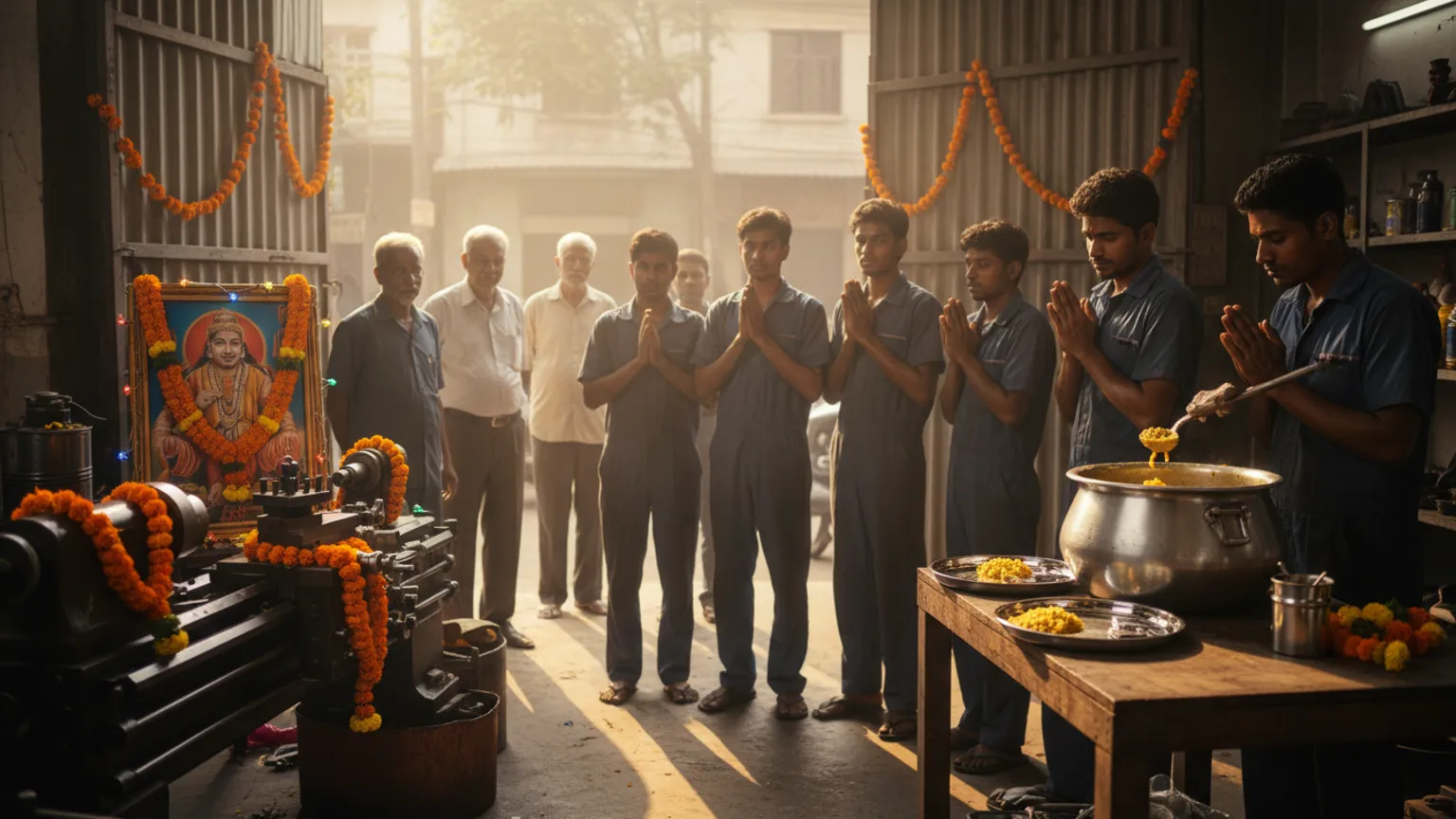
The Vishwakarma Puja I remember best was not at home. I grew up in Guwahati, and on the seventeenth of September the whole neighbourhood changed shape — every garage, cycle shop, press and tempo stand put up a small pandal, wrapped its machines in marigold, and stood a garlanded photo of Vishwakarma where the cash box usually sat. My father used to take me to the little offset press that printed his shop's bill books. The owner, whom everyone called Dulal-da, would have the lathe and the cutting machine draped in flowers by nine, and by noon there was a degchi of khichuri the size of a drum, being ladled onto steel plates for anyone who walked in.
What I understood only much later, watching him, is that the puja itself takes twenty minutes. The part Dulal-da actually worried about all week was the plates. Because on Vishwakarma Puja, a workshop does not feed its staff — it feeds its world. And that number is never the number on the salary register.
Why the workshop count never sits still
Think about who eats at a workshop bhog. Start with your permanent team, easy enough to count. Then add the daily-wage workers and helpers who come and go. The apprentice boys. The tempo and auto drivers who ferry your material and treat your puja as theirs. The supplier who drops by "just for prasad" and stays for a plate. The owner's family, who arrive after the aarti. And the neighbours and passersby, because khichuri bhog on Vishwakarma Puja is offered to whoever comes to the gate — that is the whole spirit of the day.
None of those groups tells you they are coming. That is the real shape of the problem, and it is the same trap I've written about for any puja where the prasad count and the catering count refuse to match: the number who eat is always larger than the number you planned for, and the host — here, whoever runs the shop floor — absorbs the gap in front of everyone. Run short of khichuri at a house party and it is embarrassing. Run short in front of your own workers and the drivers who keep your business moving, and it stings in a different way.
Count in three tiers, not one number
The mistake is trying to hold one figure in your head. You can't, because the crowd is genuinely three different crowds. Count them separately, a day or two ahead, and the plate maths stops being a guess.
- Core team — confirmed. Permanent staff, apprentices, the owner's family. You know these names. Ask each supervisor or section head for their own subcount rather than counting the whole floor yourself.
- Floating regulars — estimated. Daily-wage workers rostered that week, the drivers and suppliers who always turn up. You cannot confirm these, but last year's rough number plus this week's roster gets you close.
- Walk-in prasad — buffered. Neighbours, passersby, the children from the lane. You don't count these; you keep a margin for them, because turning them away defeats the point of the day.
Here is the working table I wish someone had handed Dulal-da, sized for khichuri bhog — the khichuri, labra, chutney and a sweet that most workshops in the east and northeast serve:
| Item | Rough working amount | Note |
|---|---|---|
| Rice + dal for khichuri | one full plate per head, plus 15% | Khichuri swells; better a little over than a katori short |
| Labra / mixed sabzi | half a plate per head | The cheapest thing to add volume to at the last minute |
| Chutney (tomato / plum) | a spoon per head | Small quantity, big absence if missing |
| Sweet (a laddoo or jilipi) | one per head, plus a handful spare | The children at the gate come for exactly this |
| Steel plates / sal-leaf plates | 25% over your core-plus-floating count | The walk-in tier lands entirely here |
That "25% over on plates" line is not padding. It is the drivers, the supplier, and the four children from the next lane who are as much a part of Vishwakarma Puja as your own team. Plan the food off core plus floating, and plan the plates off all three tiers.
The messages that get you a real number
The whole thing hinges on asking each section for a count instead of broadcasting "sab aa jao" into a group and hoping. A few messages you can adapt the evening before.
To your supervisors / section heads (Hinglish):
Vishwakarma Puja is on the 17th, aarti around [time], khichuri bhog after. Ek kaam karo — apni team ka count bhej do aaj shaam tak: kitne log khaana khaayenge, permanent + jo helper is week aa rahe hain. Bas ek number, taaki bhog aur plates theek se plan ho jaayein. 🙏
To the drivers / suppliers group:
Bhaiya, 17 ko workshop pe Vishwakarma Puja hai. Bhog dopahar ko — aap sab zaroor aana, prasad lekar jaana. Aa rahe ho to ek "haan" reply kar dena, count ka andaaza ho jaayega. 🙂
The owner's note to the whole floor (English + Hinglish):
This year the puja is on us and the food is for everyone who walks in — that's the whole idea. But so I don't run short, [name] is keeping the count. Apna aur ghar-waalon ka number usko bata dena by tomorrow evening. No formality, bas ek clean count chahiye.
Notice what each one does: it asks for a number, names who to include, and gives a deadline of tomorrow evening. "Do come for prasad" gets you warmth and zero planning value; "reply with how many" gets you a plate count.
Veg, non-veg, and who eats what
Vishwakarma Puja bhog is almost always vegetarian — khichuri is the point, and that side of it is simple. Where it gets fiddly is a mixed workshop or an office team: some fasting that day, a Jain colleague who won't take onion-garlic, someone who wants their plate without the sweet. On a small floor you'll just know. On a bigger one, a one-line preference alongside the headcount saves a scramble at the counter — the same discipline as tracking veg, non-veg and Jain counts for any function. Ask once, ask early, and cook the base khichuri for everyone with the exceptions noted on the side.
A morning checklist so the bhog lands on time
The food is only half of it; timing is the other half, because drivers and suppliers hold you to a slot and neighbours arrive on the aarti bell.
- Two days before: counts closed from every supervisor; rice, dal and the sweet ordered off the core-plus-floating number.
- Evening before: dal soaked, degchi and gas arranged, plates counted out with the 25% margin stacked separately.
- Morning, before the aarti: machines and tools garlanded, Vishwakarma's photo set, the cooking started so bhog is ready before people are hungry, not after.
- After the aarti: serve the core team and workers first, then the walk-in gate crowd — nobody who came for prasad leaves without a plate.
- Winding down: leftovers packed for the night-shift and the drivers who missed the slot; workspace cleared so the shop opens clean the next morning.
When your workshop needs none of this
Be honest about your own size. If your "workshop" is a five-man garage and a tea stall next door, ignore almost all of the above — you'll all eat off the same bench, one message to the group settles it, and a plate table is over-engineering for a gathering that small. The whole spirit of Vishwakarma Puja is informal generosity, and a plan can get in the way of a good afternoon.
This earns its keep only when the count crosses the point where one person can't hold it — a multi-section workshop, a factory floor, an office where you're chasing numbers across three supervisors and a drivers' group at once. That many-groups, one-count problem is exactly the kind of thing Inyeet was built for, and the gatherings it actually helps with are these — many small teams feeding into one honest number, visitors included. For a corridor puja and a shared degchi, a notebook and Dulal-da's instinct will still do the whole job better than any app.
Because that is what I actually took away from those mornings at the press. The khichuri was never the achievement. The achievement was that the last driver to arrive, an hour after the aarti, still got a hot plate and a laddoo for the road — and Dulal-da only managed that because he'd stopped guessing the number a week before, and started asking for it.
Related reading
Navratri 2026 dates and the nine-day plan for a home host
Navratri 2026 runs 11 to 20 October: the full nine-day tithi calendar, how hosting differs by tradition, and where guest-list pressure actually lands.
Can you host a party, griha pravesh or wedding during Pitru Paksha?
Pitru Paksha is traditionally no time for shubh functions. A host's honest guide to griha pravesh, weddings and parties — should you hold, move, or go ahead?
Shraddh bhoj: how many to invite and what to serve at the meal
A shraddh bhoj is a measured satvik meal, not a party. How many brahmins and family to invite, the traditional menu, real quantities, and copy-paste messages.